
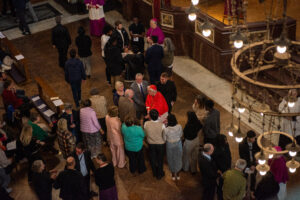
A call…
The word comes from the Latin word ‘vocare’ which means ‘to call’. Vocation, then, is about a call or a calling in people’s lives – but whose call and in whose lives?
A call from…
We believe that throughout history, God has called people to play a particular role in his plan of salvation for the world. Many of the stories in the Old Testament are about such individuals – Abraham, Noah, Moses, Hannah, Samuel, Jeremiah and Ruth, to name but a few. In the very first few lines of the Bible, in the Book of Genesis, God calls creation into existence by his Word. Throughout the Old Testament, God is continually inviting the people of Israel to be his Chosen People, to be a light for other nations. When Jesus comes, he also calls people to follow him and to live the kind of life he does. So, when we talk about vocation, we are talking about the call of God.
A call for…
But who is this call for? You might be surprised to hear that it is for everyone, including you. Many people only use the term ‘vocation’ to talk about priests, monks and religious sisters. But this can be misleading and unhelpful. Of course we believe that these people have a vocation, but to limit our understanding of vocation to these few groups of people doesn’t do justice to its full meaning. The Church believes that God calls each and every person into existence and then calls us to be a living sign of his love for the world. We are created out of love and we are created to love.
A call to…
This means that for the Christian, a vocation is not just something that God calls us to do, it is also the person God calls us to be. When Jesus called his first disciples by the Lake of Galilee it wasn’t just so that they could help him in his work, it was so that their lives could be transformed through his friendship and love. We have been called to follow Christ, the Son of God, the eternal Word of the Father, who came to save us and lead us back to heaven. He has sent his Holy Spirit so that we can share in his divine life even now, here on earth, and express that life by trying to love him and to love our neighbour as Christ loves. The Christian vocation is thus a call to share in the life of the Holy Trinity.
This draws on material adapted from “How to Discover your Vocation” by Fr Stephen Wang and “The Catholic Priest – Answering God’s Call”.
FAQ’s
Do I have a vocation?
Yes! In the words of Blessed Charles de Foucauld…
“God calls all the souls he has created to love him with their whole being, here and thereafter, which means that he calls all of them to holiness, to perfection, to a close following of him and obedience to his will. But he does not ask all souls to show their love by the same works, to climb to heaven by the same ladder, to achieve goodness in the same way. What sort of work, then, must I do? Which is my road to heaven? In what kind of life am I to sanctify myself?”
Created to share God’s love. The fundamental vocation of every human being is to love. This is not obvious to everyone today. Many people believe that human life is just an accident, a chance product of evolution, a meaningless event in a vast mechanical universe. It is certainly true that our lives have been shaped by many different forces, but there is a much deeper truth which we can discover through faith: Every single human being has been created by God out of love. He has made us so that we can know his love, and share that love with others, and delight in that love forever in the glory of heaven. So whatever you feel about your own worth – never doubt that your life has a meaning. God loves you and cares for you. You are precious to him and he has a purpose for your life, even if that does seem very clear to you.
Vocation as a call to holiness. One way of understanding this purpose of your life is to say that the fundamental human vocation is the call to holiness, the call to be a saint. The saints are not just heroic people who live in history books. They are ordinary Christians who have tried to live their faith without holding anything back – to love God with their whole hearts, to love those around them without counting the cost, to dedicate their lives to what is most worthwhile, to be people of joy and kindness and prayerfulness. All of us are called to be saints – however weak or sinful we feel, whatever wrong choices we have made in the past. As we read in the first letter of Peter: “As he who called you is holy, be holy yourselves; since it is written, ‘You shall be holy, for I am holy.’” (1Pet. 1:15-16). This call to holiness is not so much a command as a promise which God makes: he promises us, by giving us his Holy Spirit through baptism, that he will help us to find our true happiness in following him, and that he will give us whatever we need for the journey.
You already have a vocation. This call to holiness is already a part of your life, given to you at your baptism, and it is so important to remember that. Whatever situation you are now in, however unsatisfactory it seems, you already have a vocation. You might be working or unemployed, studying or starting a family, travelling or caring for someone at home; full of hope or close to despair. Whatever your situation, you can trust that God is with you, and that he calls you to be holy in this very situation. Things may well change – and perhaps they need to. But at this moment you must have the trust to believe that even now there is a meaning and purpose to your life; and that you can begin to fulfil this purpose through everyday acts of love, kindness and patience.
Living well in the present. This call to live well in the present is the ‘Little Way’ recommended by St Thérèse of Lisieux – the importance of simply doing your duty, making time for prayer, loving your neighbour, bearing your sufferings; and doing all this with a generous and loving heart. It is not very dramatic, but it is the secret of holiness, and it reminds us that your first and fundamental vocation is not something to be discovered in the future – it is living the Christian life in the here and now. Perhaps this is all God wants of you for the moment. You must avoid the temptation of thinking that your Christian life can only properly begin in the future, when everything is crystal clear. And if you do not discover a more concrete vision, or if you are to die young, then you should not feel that you have wasted your life, or that your life is unfinished or unfulfilled. As Pope Benedict has reminded us:
“We are not some casual and meaningless product of evolution. Each of us is willed, each of us is loved, each of us is necessary.” (Homily of Pope Benedict XVI, 24th April 2005, Mass of the Inauguration of the Pontificate)
This is adapted from the CTS booklet ‘How to Discover your Vocation’ by Fr Stephen Wang
Do I have a particular vocation?
Vocation as a call to a concrete ‘state of life’. Christ has always called some people to follow him in particular ways, by giving them a more specific vocation as well as their baptismal calling to holiness. In previous generations, the word ‘vocation’ would have been used to describe the lives of priests and religious – because they had been called ‘away’ from an ordinary life to a life of celibacy and service in the Church. But today the word ‘vocation’ is rightly used also of marriage, the permanent diaconate, consecrated life, and some forms of single life – because each of these is a wholehearted commitment that we make in response to an invitation from the Lord. These particular vocations are also known as ‘states of life’, because we make a lifelong commitment to living our Christian faith in a particular context. This lifelong commitment becomes the place in which we live out our fundamental vocation to holiness. God calls us to be saints; and sometimes he calls us to be saints in a particular way – as husbands or wives, as priests or deacons or consecrated persons.
Vocation as a call to be the unique person you are made to be. Just as each saint is unique, so you are called to be holy not just in a general way, but in the particular way in which God calls you to be. God has created you as a unique individual, and calls you by a name that no-one else has been given. You are to reflect Christ’s love and show something of his face in a way that no-one else can. This is your ‘personal’ vocation – the call to be the person you are meant to be. We are therefore invited to understand our lives as a mission from God in which each one of us is called to play a unique part in God’s plan of salvation for the world. This idea was powerfully expressed by Blessed John Henry Newman in these inspired words:
“We are all created for God’s glory –
We are created to do his will.
I am created to do something or
to be something for which no one else is created.
I have a place in God’s world, which no one else has:
Whether I be rich or poor, despised or esteemed,
God knows me and calls me by my name.
God has created me to give him some definite service.
He has committed some work to me
which he has not committed to another.
I have a mission – I may never know it is this life,
but I shall be told in the next.
Somehow I am necessary for his purpose.
I have a great part in his work.”
This article was adapted from the CTS booklet “How to Discover your Vocation” by Fr Stephen Wang.
How can I discover my vocation?
When we understand that God has a desire for each one of us, the natural question is, “What is God’s desire for my life?” The whole process of listening to God and listening to our own hearts for an answer to this question is something which we call ‘discernment’. This is usually a gradual process of coming to know who God is calling us to be – it is not something we just decide to do one afternoon, like watching a film or calling up a friend. It is a journey which involves patience, honesty, perseverance, generosity, courage, and a sense of humour! It is a personal journey which will also involve trusted friends and the wider Christian community. Within all our discernment we are trying to hear the invitation of Christ to follow him in a particular way and to become the person he wants us to be.
In every individual human vocation it is God who takes the initiative – our role is to listen and respond. But how to do this? Christians talk about how God ‘calls’ us to do something, and perhaps we think this means that one day we will literally hear a voice telling us what to do. Sometimes God does speak to us in clear and dramatic ways, but more often he ‘speaks’ to us in ordinary ways. He guides us through the deepest desires of our hearts (calling us ‘from within’) and the events and circumstances of our lives (calling us ‘from without’). Below is a list of some of the many ways that God can guide you and pull you in a certain direction – whether it concerns a small choice, a medium-sized career move, or a lifelong commitment. Beneath everything, you are trying to know God’s will for you, to listen to the stirrings of the Holy Spirit deep in your heart, and trying to respond generously. It is about a personal relationship with the Lord.
You don’t need to over-analyse your life, looking for conclusive signs in every mood or event. This can become an obsession, and even a superstition, like reading the tea leaves or the horoscopes. The ‘signs’ listed below simply point to areas of your life that it can be fruitful to pay attention to, ‘listening’ to what they mean. When you stand back and take a look at the bigger picture, perhaps a pattern emerges, and you sense that you are being drawn in a particular direction. Usually, you don’t need more ‘signs’, you just need to look and listen more carefully to your own life.
1) Calls ‘from within’:
Desire and attraction – What do you really care about? What do you love? What do you feel passionate about? What would you love to commit yourself to? What do you feel pulled towards – even if you can’t explain why? When does your “heart burn”, like the two disciples who met Jesus on the road to Emmaus?
Admiration – Who do you most admire? Is it because of who they are/what they do or what they stand for? What is it about them or their vocation that most attracts you? What does it stir up in your own heart? Which living person would you most like to be? Which saints/figures from the past inspire you most? Why?
Enjoyment – What do you like doing; not just for leisure or fun – but what kind of work and activities do you find most fulfilling? What brings the best out of you and gives you the deepest satisfaction?
Skills – What are you good at? What are your gifts, skills and aptitudes? Not just your qualifications (although these are often relevant) but your gifts of character and personality too. How could you best use all that God has given to you and make a difference?
Real value – of the many projects and careers you are interested/involved in, which of them do you think are really worthwhile? What do you actually believe in and want to promote in the world? This doesn’t mean that you have to choose an overtly ‘religious’ or ‘charitable’ work – as if all the ordinary jobs that people do in the world are a second-best option for Christians, but you have to have a commitment to what you are doing, you have to believe in it. This of course means that you should avoid any choices that take you into an area that is corrupt or immoral, and above all avoid any wrong-doing yourself.
Inner conviction – You might have a clear, inner conviction that something is right for you; almost like an unshakeable knowledge of who you are and what is important for you. More than just a desire or an attraction – it is like a sense of inevitability, part of your identity. It might have been a part of you as long as you can remember; or it might have dawned slowly; or it might come upon you in a moment of inspiration. This inner conviction is not an infallible sign of your vocation – it might need interpreting or purifying – but it is certainly something that you should listen to carefully.
Prayer – When you are praying – talking to God, asking his help, or just sitting in silence – do certain ideas keep coming back to you? When you let go of your distractions for a moment, and open your heart to God in prayer, it can allow your deepest concerns to come to the surface, and allow God to ‘speak’ to you. Sometimes an idea comes to mind in prayer, or a memory, or a concern, or a task. It nags. It seems important, it seems especially meaningful. And when you reflect on it later on, it still seems important for you. This might be an ‘inspiration’ from the Holy Spirit – not in the sense of an infallible divine command, but a nudge in your heart or mind to look into something more deeply.
2) Calls ‘from without’:
Holy Scripture – In a similar way to your prayer life, when you are reading the Bible on your own, or listening to the Scripture readings at Mass, a phrase can strike you with unexpected force. A passage that you have heard many times before can suddenly seem clear and powerful. It moves you or challenges you or almost impels you to do something. You feel as though God is speaking to you personally and directly through the words of the Bible, or through a sermon or talk. You might, for example, suddenly identify with the experience of a particular person in the Bible and see your own pathway illuminated by theirs. All of this is another way that the Holy Spirit can inspire and guide you – pointing you, through these words and the response they evoke, to something that is important for you.
Other people – If people encourage you in a particular decision or way of life, if they ‘believe in you’, this can be a sign that you are going in the right direction. Sometimes other people can see your own potential more clearly than you can yourself. You might be afraid or lacking confidence, but they can see the possibilities, and encourage you to go in one direction or perhaps discourage you from going in another direction. It’s good to talk to people that know you well, people you trust – friends, family, teachers, priests – and see what they think about your ideas for the future. They might have another perspective that helps you. But other people can also get things wrong or have their own agendas, and become over-enthusiastic about your vocation, or project their own ideals onto your life – so you need to be cautious and not follow the advice someone gives you uncritically.
Events and circumstances – Sometimes an opportunity opens up unexpectedly and you want to make the most of it. It wasn’t planned, and you are not quite sure how it fits into the rest of your life, but you feel an instinctive enthusiasm, and you want to ‘seize the day’. Or you are waiting for an event to unfold that is now beyond your control: exam results, feedback from a job interview, a medical report. You may have a passionate desire to follow one path, but circumstances make it impossible. The Lord opens doors, and closes them, through the ordinary events of your life, through the decisions that others make, and through the concrete situations you are in. You can trust that God is guiding all these circumstances and leading you to where you are meant to be. He is more powerful than all the other forces that seem to be shaping your life.
Extraordinary experiences – Not often, but sometimes, God steps into our life in a quite extraordinary and unexpected way. You ‘hear’ a voice in prayer, or ‘see’ a vision, or witness a miracle – and you are quite convinced that this is God’s direct work, and that he is speaking to you personally in this way, and guiding you in a certain direction or requesting something of you. You have to be very careful here: you can deceive yourself, and harmful spiritual forces can trick you into believing what is not true. You should never just trust these experiences uncritically – you should talk about them with a wise priest/spiritual director, and try to make sense of them in the light of all the other ways that God us guiding you. Many people do not have such experiences. We should not expect them. And there is no need to ask or pray for them. God usually prefers to guide us in ordinary ways. But sometimes it does happen!
3) Summary
God ‘speaks’ to us in all these different ways. Life is not like a crossword or a Sudoku puzzle, where we have to analyse every clue and complete every answer in order to come to the end and reach a tidy conclusion. We simply get on with life, doing the best we can – ‘listening’ to God, paying attention to all these different ways listed above, seeing if there is a pattern, stopping to reflect when something strikes us with a new force or clarity. Usually, gradually, we find that we are being pulled in a certain direction, or we have enough to help us make a decision. And then, with trust and faith in God, we take the next step.
This article is adapted from the CTS booklet ‘How to Discover your Vocation’ by Fr Stephen Wang.
How can the Church help me to discern my vocation?
The Greek word for Church is ekklesia, which means those who are ‘called forth’ by the Lord or those who are ‘called from all nations’. Together we become, as St Paul says, the “Body of Christ” with Christ as the head. This image helps us to understand that, just as God is a community of three persons, so we too are created and called by God to live in community, to seek salvation together and not individually. As Christians we are to live our lives not like a solo-round the world yachtsman but as a pilgrim people, helping and encouraging each other on our journey with and to God. This is the mission of the Church – to be a living sign of God’s kingdom here on earth and to continue Christ’s own mission of leading humanity to eternal life with God the Father in heaven.
This means that our unique vocation is given to us so that we may build up the Church and so be living cells within the Body of Christ. To serve the Church we must love the Church, with all its human weaknesses and sinfulness, and seek through the power of the Holy Spirit to be agents of its renewal and sanctification. In the Church we come to know Christ in his Word and Sacraments, in the presence and service of others and in prayer and silence. Through coming to know Christ we are able to know better our true self. And, as Pope Benedict told the young people in front of Westminster Cathedral during his visit to England, “… in discovering our true self we discover the particular vocation which God has given us for the building up of his Church and the redemption of the world.”
Below are ten ways in which we can truly be ‘living cells’ in the Church and so be helped to discern and live out our vocation:
1) Commit yourself to a particular Church community – Many people today, especially in a huge city like London, live rootless, almost nomadic lives in which they struggle to put down roots in any particular community or neighbourhood. It is possible to live an anonymous, solitary life while surrounded by great crowds of people. The same is true of many Catholics today who float from one parish to another or attend Mass infrequently. This inevitably means that such a person has little or no sense of belonging to or of personal involvement in the Church. If we really want to serve the Church, we need to make a definite commitment to a particular community, which for some may be a university or ethnic chaplaincy, but for most people will be their local parish. It is here that we gather as the People of God to be nourished and formed by Christ in the Eucharist, to receive his forgiveness through the Sacrament of Reconciliation and where we live out our calling to love one another through acts of service. If we truly want to serve the Church, then we must be known by the Church in the shape of a particular community with its priests and congregation. It is often these people who will see in us our unique gifts and deepest calling – the vocation through which we are to serve God in our lives.
2) Go to Mass as often as possible – The Eucharist is our most powerful encounter with Jesus Christ in which he gives himself fully to us so that we may become ever more strongly united to him. In the Eucharist we are formed by God’s Word and learn how to love as God loves – unconditionally, with compassion and total self-giving. Go to Mass as often as you can and you will grow in your relationship with God, with others and in your own self-understanding. It is important to prepare well for Mass by reading the readings beforehand so that God’s Word is already alive and active within you and by arriving in good time so as to be concentrated and really present to God just as he will be fully present to you during the Eucharist. Make the Eucharist the centre of your life and your life will be transformed.
…and find time for Eucharistic adoration – Most parishes offer a time of Eucharistic adoration at one or several times every week. Seek out such a time whenever you can and simply be in silence before our God. This experience of Christ’s presence in the Blessed Sacrament draws us ever closer to him and helps us to know a deeper peace and clarity in our lives.
3) Be faithful to the Sacrament of Reconciliation – To know God’s deepest desire for our lives, we need to stand in the truth. In the Sacrament of Reconciliation we are invited to live in that fullness of truth which can only be found in God. We are invited to take off all our masks and pretences and receive the forgiving, healing presence of Christ so as to become our true selves. The priest is Christ’s instrument in helping you to know God’s mercy and to understand your deepest self. Through regular celebration of this sacrament we learn to recognise those patterns of sinfulness and self-centredness which hold us back from becoming the person we have been created to be.
4) Read and pray with God’s Word – We can often take for granted the extraordinary gift which is God’s Word spoken to us every day during Mass. This is a Word which is alive and active, revealing to us the truth of our human nature and of God’s desire to reveal through us his love for the world. In the Scriptures we hear about those who have been called throughout history to be God’s prophets and poets, we hear in the Scriptures how Jesus called and formed the disciples so that they could continue his mission on earth. In these individuals we encounter our own story and if we allow God’s Word to find its home in us then we too can be shaped by its power. Many parishes have Bible study groups or faith-sharing groups – for many people such small communities have helped them to discover that God’s Word is a word spoken to us personally today, a word which can illuminate and transform our lives.
5) Live a life of prayer – Prayer is the lifeblood of friendship with God. Make a commitment to daily prayer and be faithful to it. Choose a time and place where you can simply be in silence before God – if possible start and end each day with such a time of heart to heart communion with God. Different forms of prayer speak to different people – so keep asking Jesus to teach you how to pray, as he did the first disciples. It is good to experience both individual, personal prayer and also communal prayer, which once again should be on offer in your parish – the rosary, adoration, novenas, charismatic prayer, the Stations of the Cross during Lent… Prayer is always a journey – sometimes it can be dry and hard-going and other times it brings us great inspiration and consolation. The heart of prayer is desire, so seek out this precious time with God where he is waiting to lead you step by step into his deepest desire for you.
6) Go on an annual Retreat – the
7) Talk to your priest – Every priest is called to be a good shepherd to his flock in imitation of Jesus Christ himself. He is there to guide and support you on your journey, to help you understand how God is at work in your life. Priests come in many forms and character types, some more approachable than others (!) but, be assured, there is nothing more encouraging for a priest than when someone comes to him in all sincerity to ask how they can live their Christian life more deeply. Make an appointment to talk to your priest and explain to him in all humility and truth the journey you are travelling so that he can know how he can best support you on the journey ahead. He can, at the very least, put you in contact with others, such as your diocesan Vocations Director, who can help you to move forward.
8) Find a Spiritual Director
9) Get involved – It really is true that the more we give the more receive. Parishes are not businesses which employ people to get things done, they are communities of faith which rely on the generosity of their parishioners to share their time and talents so as to bring that community to life. When you are settled in your parish, ask your parish priest how you could best contribute to the life of the community through your own particular skills and gifts. Whether it’s through cleaning the church or helping to pass on the faith to others, helping with the parish administration or the ministry to the homeless, you will come to live out your faith in practical ways which will help you to understand better what God’s particular plan is for how you are to serve him in the Church and in the world. It is through working together that we really come to know each other and ourselves better.
10) Through the parish, come to know your diocese and the universal Church – Finally, every parish is not meant to be an island – inward-looking and disconnected from the wider world. On the contrary, the parish is to be a community through which we can also experience the universal Church. Parish notice boards and newsletters are usually packed with activities and opportunities to help you enter more deeply into the life of your diocese. Seek and you shall find! Every diocese has a Vocations Director who will be organising various initiatives to help young Catholics live out their faith more deeply – such as a monthly Vocations Discernment Group and regular retreats. Your diocesan Youth Services will also be organising different events to bring together young people from across the diocese. Check out your diocesan website (for Westminster this is www.rcdow.org.uk) for news of all that is happening in the diocese and, once again, do not be afraid to get involved. From time to time there will be an opportunity through your parish, through your diocese to be a part of an experience of the universal Church such as a local group travelling to participate in a pilgrimage to Lourdes or to a World Youth Day. Such an opportunity to experience the Church in its fullness, gathered in prayer and celebration around the Successor of Peter, is one which has led many to understand God’s calling for their life and how they are to live out this calling within the Church, whether that be in foreign fields or back in their local community.
These reflections were prepared by Fr Richard Nesbitt
What can get in the way?
“My Lord God, I have no idea where I am going. I do not see the road ahead of me. I cannot know for certain where it will end. Nor do I really know myself, and the fact that I think I am following your will does not mean that I am actually doing so.
But I believe that the desire to please you does in fact please you and I hope that I have that desire in all that I am doing. I hope that I will never do anything apart from that desire. And I know that if I do this, you will lead me by the right road, though I may know nothing about it.
Therefore I will trust you always though I may seem to be lost and in the shadow of death. I will not fear, for you are ever with me and you will never leave me to face my struggles alone.” (Thomas Merton)
Many factors can get in the way of our vocation: they can make it difficult to discern or difficult to make a commitment once we have discerned. There is not enough space here to look carefully at all these difficulties. Sometimes it is enough just to flag them up, so that if they are present in your life you can notice them more easily and face them more honestly. Below are ten of the most common difficulties that arise when people are discerning their vocation, together with a single thought or two about each one to encourage or help you. If you meet a real difficulty, pray about it, and talk to someone about it, so that it does not become an insurmountable obstacle.
1) Worry, anxiety and lack of trust in God – Try not to worry! Be at peace. Trust that God is more powerful than all your worries. With complete honesty and trust tell him your anxieties, and put them in his loving hands. Your anxiety may come from a distorted image of God. You may think that he is like an absent parent who doesn’t love you, or a vengeful tyrant who is constantly punishing you for something, or a self-interested boss who wants to force you into a vocation that will not be right for you. Instead, trust him. He is a tender Father who is both loving and demanding. He cares for you more than you care for yourself. Sometimes he might challenge you and call you to something unexpected – but it will always be for your ultimate good and happiness.
2) Noise, busyness, overwork – It seems that we live in a society where the pace of life is constantly accelerating and so many of us struggle to hear God’s call because we never really make any time or space in our life to listen to him. Every hour is filled up, and your mind is constantly cluttered with work, noise, music, and many other distractions. It may well be that your life is full of good and worthy activities and that you have problems saying “No” so that there are more and more demands on your time. You need to prioritise, just as Jesus did, to swim against the tide of over-activity so that you make sure that amidst all this busyness you have time for yourself and for God. Make real space for God in your life and for at least some moments of silence each day.
3) Sin, worldliness – Sometimes we can fool ourselves that as long as the externals of our faith life are in order – Sunday Mass, some involvement in Church life – then all is well. However, for many people the rest of their week can be almost totally divorced from their “Sunday best”, and their prayer life almost non-existent. The deeper reality of our lives may be that we are trapped in some habitual sin or caught up in a completely worldly lifestyle, which will make it impossible to listen to our own heart or to God. Be honest with yourself; go to confession; try to make a new start, even if you are struggling, so that your whole life is consistent and not a fragmented mess. Don’t fool yourself that you can do this alone – you need the help of good friends and a community of faith such as a parish or a prayer group to support you through this time of change.
4) Addictive behaviours – Alcohol, drugs, pornography, promiscuous sex, gambling – these can become poisonous, toxic forms of slavery which can totally blind us to God’s presence in our lives. Even activities that are harmless in themselves like work, going to the gym, texting, the internet, gaming, Facebook – if we allow them to take over our lives then they can become like addictions which cover up our deepest needs and cut us off from our true selves. Look honestly at what activities take up most of your time – as Jesus said, “Where your treasure is, there your heart is also.” Seek God’s help in prayer and through the Sacrament of Reconciliation. Try and break any addictive patterns of behaviour you are trapped in. And if you can’t – then get help.
5) Fear of commitment – We rightly value freedom, but in the Western world we often understand freedom as simply being the ability to choose from an endless variety of options. In this light, commitment to anything, let alone for life, seems like a limitation, even a loss of self. But to have a series of endless options is actually to have no options – because you never embrace any one of them with your whole heart. Life can become like the endless flicking from one TV channel to the next in which we never actually decide to watch one particular programme from beginning to end! God may be inviting you to take responsibility for your own life and make a lifelong commitment, to put down roots so that you can truly flourish, to build one concrete life rather than endlessly fantasise about innumerable possible lives. It is often better to do one thing with unreserved commitment than to drift through life without any firm sense of purpose.
6) Fear of your own unworthiness – Perhaps you fear that you are not the right person for this vocation, even though you feel attracted to it. You worry that you are not holy enough, not intelligent enough, not qualified enough, not loving enough, to shy, too sociable… Perhaps you are right. But perhaps you are underestimating yourself or underestimating God. He chooses the weak and makes them strong. Sometimes he invites us to do what seems impossible, and only later on gives us the strength to do it. Why not take the step anyway – and let God decide further down the line if it is really for you or not.
7) Fear of failure – In our very success-driven society, many can be paralysed when making a particular commitment by a fear of ‘getting it wrong’ in the eyes of others. The truth is that any lifelong commitment will involve some sacrifice and cost – a time of giving up and letting go. But if we are honest it is often through the apparent ‘failures’ in our lives that in the long term we develop and grow the most. If this is the right step for you then God will sustain you. If he wants you to flourish and find happiness here, then you will. If he is really leading you somewhere else, and it seems like you have failed in your provisional decision to try a vocation – then trust that this will be part of his loving plan. He writes straight with crooked lines. What matters is not success or failure, but whether you have tried to be faithful to his call at each moment.
8) Opposition from people you love – Your family or friends are against you taking this step. It may be true that they have some insight that you don’t have, and you should certainly listen to them respectfully. But it may be that they are unable to support you in your vocation because of their own lack of faith or personal fears. Sometimes you need to be strong and do what you feel is right, even in the face of opposition or misunderstanding. At the end of the day it is your life. If you have carefully discerned that this is the right step, then explain it as best you can to those you love, and take the next step courageously – trusting that God will help them to understand or at least accept it at some time in the future. Indeed, it may well be that God wants you to be an instrument for change and conversion in their lives so your short-term pain may well be a means to long-term grace.
9) Opposition from the culture and society – Same vocational choices, even Christian marriage, will sometimes be misunderstood or even mocked by contemporary society, and perhaps by friends and colleagues. Recognise that to be a Christian will involve some misunderstanding and even persecution, especially if you are making a radical lifelong vocational commitment. Be as loving and as kind as you can, and explain your choices gently to people if they ask. Don’t stir up opposition and seek controversy. But if it comes, don’t be deterred.
10) Desire for certainty and perfection – It is unlikely that you will ever be 100% certain about any significant choice – of course there are doubts and questions. But you can be sure that this is a reasonable step to take if things come together and the time seems to be right. Yes, it’s a risk. But it’s also a risk not to make a choice. Life is full of risks. God is always with us, supporting and guiding us – even if we make a decision in good faith and things seem to go wrong.
Perhaps your problem is that you won’t make a commitment until everything is perfect and all your questions have been answered. Perhaps you want to be a religious brother or sister but you can’t find an order that is good enough for you; you want to be a diocesan priest but don’t like the bishop in your diocese; or you want to be married but no-one matches up to your standards. It may be that you haven’t found the right person or diocese or order yet; but it may be that you need to settle for what is ‘good enough’. No person or congregation is perfect, and if you are looking for perfection you will never find it. The search for perfection might strangely be a way of avoiding a vocation. Try the 80% rule: if 80% of what you are looking at is good – then that’s pretty good! Perhaps you can live with the other 20%, or see it in a new light, or change it (or maybe it is you who needs to change!).
This article was adapted from the CTS booklet “How to Discover your Vocation” by Fr Stephen Wang.
What is the ‘Call to Christ’?
Blessed John Henry Newman on “The Call of Christ”
Blessed John Henry Newman wrote extensively on vocation. In ‘Parochial and Plain Sermons’ , Newman considers what the ‘Call of Christ’ is and how we can discern what Christ is calling us individually to do.
We are not in this journey of discernment alone! God calls us through our baptism to be a “living cell” in the Body of Christ, the Church – to be an active member of this community and so to learn from each other as fellow pilgrims on our journey through life. One of the greatest gifts given to us in the Church is the treasury of wisdom of the saints – men and women across the ages who have lived every kind of life imaginable but who have all been united in their common search for God and their desire to be ever more faithful disciples of Christ. There is perhaps no struggle or crossroads which we can face in life which will not be echoed in the lives of different saints and through coming to know their trials and triumphs we can receive light and inspiration for our own journey.
Below is a beautiful reflection from Blessed John Henry Newman, whose whole life was dedicated to knowing and living God’s will. His was a restless soul, always seeking to put out into deeper and deeper waters. Pope Benedict XVI described Newman as “a person always converting, a person in a constant state of transformation, and thus always becoming ever more himself in the hands of God”. Here Newman reflects on this call of Christ, which is a “Golden Thread” woven through our whole earthly life. Enjoy!
“All through our life Christ is calling us. He called us first in Baptism; but afterwards also; whether we obey His voice or not, He graciously calls us still. If we fall from our Baptism, He calls us to repent; if we are striving to fulfil our calling, He calls us on from grace to grace, and from holiness to holiness, while life is given us.
Abraham was called from his home, Peter from his nets, Matthew from his office, Elisha from his farm, Nathanael from his retreat; we are all in the course of being called, on and on, from one thing to another, having no resting-place, but mounting towards our eternal rest, and obeying one command only to have another put upon us. He calls us again and again, in order to justify us again, again, again and again – to sanctify and glorify us.
It were well we understood this; but we are slow to master the great truth, that Christ is, as it were, walking among us, and by His hand, or eye, or voice, bidding us to follow Him. We do not understand that His call is a thing which takes place now. We think it took place in the Apostles’ days; but we do not believe in it, we do not look out for it in our own case. We have not eyes to see the Lord; far different from the beloved Apostle, who knew Christ even when the rest of the disciples knew Him not. When He stood on the shore after His resurrection, and bade them cast the net into the sea, “that disciple whom Jesus loved saith unto Peter: It is the Lord.”
And these Divine calls are commonly as indefinite and obscure as in former times. The accidents and events of life are one special way in which the calls I speak of come to us; and they are in their very nature sudden and unexpected. A man is going on as usual; he comes home one fine day, and finds a letter, or a message, or a person, whereby a sudden trial comes on him, which, if met religiously, will be the means of advancing him to a higher state of religious excellence, which at present he as little comprehends as the unspeakable words heard by St Paul in paradise. By a trial we commonly mean, a something which, if encountered well, will confirm a man in his present way; but I am speaking of something more than this; of what will not only confirm him, but raise him into a higher state of knowledge and holiness. Many persons will find it very striking, on looking back on their past lives, to observe what different notions they entertained at different periods, of what Divine truth was, what was pleasing to God, and what things were allowable or not, what excellence was, and what happiness. I do not scruple to say, that these differences may be as great as that which may have existed between St Peter’s state of mind when quietly fishing on the lake, or Elisha’s when driving his oxen, and that new state of mind of each of them when called to be an Apostle or Prophet.
Act up to your light and you will be carried on, you do not know how far. Abraham obeyed the call and journeyed, not knowing whither he went; so we, if we follow the voice of God, shall be brought on step by step into a new world, of which before we had no idea. This is His gracious way with us. He gives, not all at once, but by measure and by season, wisely. Each truth has its own order; we cannot join the way of life at any point we please; we cannot learn advanced truths before we have learned primary ones.”
From Parochial and Plain Sermons, viii