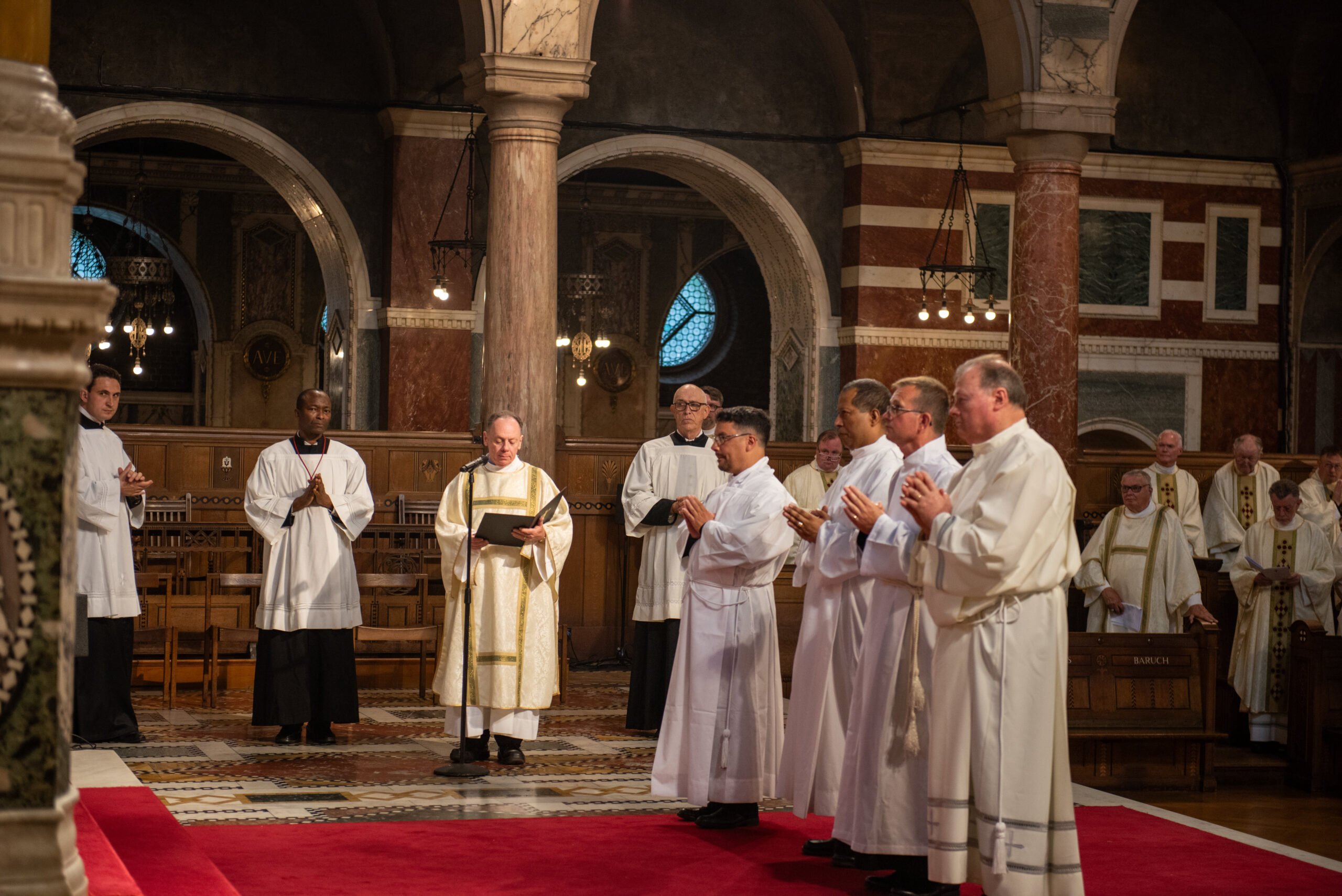

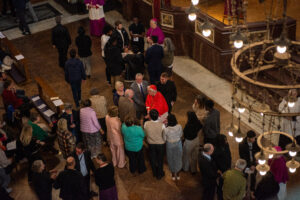
Since the earliest days of the Church, men ordained as Deacon by the Bishop of his diocese has served the Church in a three-fold ministry:
- The Ministry of Charity
- The Ministry of the Word
- The Ministry of the Altar
As well as parish ministry, deacons are engaged in a variety of other ministries, including school, prison and hospital chaplaincy.
A man considering a vocation as a Permanent Deacon will have the support of their parish priest, be actively engaged in the life of their own parish, and already be involved in works of service and exercising some leadership roles within this community.
Becoming a Deacon
What is a Deacon?
Deacons have been present in the Church since the earliest years of Christianity, appointed by the Apostles to assist with caring for the poor, and the practical organisation of Church.
The early Church was led by Bishops assisted by Deacons, who dealt with administration and feeding of the poor, as well as having preaching and liturgical roles.
As the Church grew, the role of elder or presbyter or priest devevloped, who ran the local Church on behalf of the Bishop. The role of the Deacon became largely overtaken by the role of the priest, although Deacons as permanent ministers have been present throughout the life of the Church.
Although often seen as a step in preparation for priesthood, the Church in recent times has recognised the importance of the role of the Permanent Deacon, as the sign of Jesus Christ the Servant in the Church – a ‘Diaconal Church’, and in the wider community.
A Permanent Deacon can be a single man, or a married man.
A Deacon is a man called by the Bishop of the Diocese to Ordination.
He is ordained to serve the Church in a threefold ministry
The Ministry of Charity –
He is particularly called to serve the poor, the vulnerable and the marginalised.
He will coordinate the local Church’s response to their needs.
He will have a special care for matters of social justice.
He will foster and support parish groups and organisations.
The Ministry of the Word –
He will proclaim the Gospel and sometimes preach at Mass and other Religious Services.
He will preside over Services other than the Mass.
He will lead the people in Prayer
He will officiate at Funeral and Burial Services.
The Ministry of the Altar –
He will offer Service at the altar at Mass assisting the Bishop or Priest.
He will distribute Holy Communion at Mass, in hospital and in the homes of the sick, the housebound and the dying.
He will Baptise and prepare people for the Sacrament of Baptism.
He will officiate at Marriages and prepare couples for that Sacrament of Marriage.
The Deacon will continue to be a sign of Christ the Servant throughout their lives.
Above all, they will be men of faith and prayer, with a desire to serve others for the sake of God’s kingdom.
Who can become a Deacon?
For the Diocese of Westminster, enquiries to join the the Permanent Diaconate Formation Programme are welcome from men between 30 years and 60 years of age (with ordination by 65th birthday). Those who are married must have the support of their wife and family, and accept that if their wife should die before them, they cannot re-marry and would live in the celibate state. Any candidate must demonstrate the necessary maturity and stability for this life-long commitment. Most candidates will be in the world of work and continue to be so after ordination. Indeed it is the role of the Permanent Deacon to have “one foot in the sanctuary and the other in the workplace”. Also ministering in the parish and beyond, the Permanent Deacon will be ‘as familiar with the fringes of society as with the sanctuary’.
Above all, they will be men of faith and prayer, with a desire to serve others for the sake of God’s kingdom.
Enquiry and Application
For enquiries through the year initial interviews are undertaken by one of the directors. Also, during January to March there is a series of introductory mornings which marks the start of the application process. The process is one of constant discernment, and may lead to acceptance onto the Diaconate Formation Programme. Acceptance onto the programme does not automatically mean acceptance as a deacon.
On enquiry, the man will be interviewed by diaconate directors, and the Parish Priest will be contacted to ascertain suitability. There will also be a home visit to assess family circumstances. For a married man to be accepted onto the formation programme he will need written permission from his wife. If considered suitable, the man will be invited to submit a formal application, have references are taken up and psychological assessment. This is followed by a Selection Conference, with formal interviews for the man and if married, his wife, and also as a couple. Shortly aftwards the applicant with his wife if married, will be interviewed by the Cardinal Archbishop, who with the support of information received, makes a decision on whether or not the man is accepted onto Aspirant Programme and the start of formation.
Propaedeutic Period
This propaedeutic period is a period of continued discernment ahead of the three years of formal study.
The applicant, if considered by the Archbishop as suitable for diaconate formation, is accepted as an Aspirant. As Aspriant, he enters a Propaedeutic Period of continued discernment, a period of ‘putting on the mind of Christ’. This perod includes parish-based formation and entry onto the Aspirant Programme.
The link with the aspirant’s home parish is crucial, as he must have the support of his parish priest and the community in which he will serve after ordination. The aspirant will already be deeply rooted and engaged in the parish, be involved in works of service, and exercising some leadership roles within this community. The Propaedeutic Period, builds on parish experience, ensuring that the aspirant is familiar with all aspects of parish life, and working collaboratively with the Parish Priest in tending to the pastoral needs of the parish. A parish-based programme will be agreed with the parish priest, involving the aspirant in aspects of Prayer & Liturgy, Parish & Community life, Catechesis & Faith Formation programmes, Caritas &Social Action, and Evangelisation & Ecumenism.
The one-year Aspirant Programme includes four study days at St Mary’s University, Twickenham and a retreat weekend. The programme explores the call to vocation, the importance of discernment in relation to family and work, prayer & spirituality, and the role of the deacon in the ministry of word, liturgy and charity.
Studies
At the end of the Propaedeutic Period, the aspirant will start formal studies lasting three years, culminating in a degree. The study programme starts in September, and if all goes well, by December of the first year the aspirant is admitted by the Bishop as a Candidate for the Permanent Diaconate.
During the three-years of study and continuing formation, the focus is on the human, spiritual, intellectual and pastoral development of the candidate. Topics covered include philosphy, theology, scripture, ecclesiology, spirituality, catechesis, liturgy, Canon Law, Church history, Catholic Social Teaching, Pastoral Ministry, and other related subjects. Through each of the three years of the formation programme, there are eleven Formation Days, held on Saturdays at St Mary’s University Twickenham, two study & practice weekends and a retreat weekend. Attendance at all formation days and weekends is mandatory. The studies will lead to a Foundation Degree in Pastoral Ministry, and Postgraduate Certificate in Catholic Social Teaching.
Each year there is an assessment process. The assessments facilitate the process of discernment, God’s call to the individual candidate. Therefore, acceptance of the applicant into the formation programme does not automatically mean acceptance for ordination. If all is well, the candidate is instituted as a Lector at the end of the first year of formal training, the following year as Acolyte, and finally Ordained a Permanent Deacon at the end of the third year of the study programme.
Ordination
The role of a Deacon, once Ordained, will depend on the individual, their skills and experience, and their availability in the light of their family and work commitments, as well as on the needs of the Diocese and the Parish. A formal Diaconal Agreement is agreed ahead of Ordination, detailing the expectations on the Deacon in his ministry. The primary vocation of a married deacon will be his wife and family, and his work, as deacons do not receive a stipend.
As well as parish ministry deacons may be engaged in a variety of other ministries, including school, prison and hospital chaplaincy. However, all Deacons need to be able to work within their Parish if called to do so. Deacons who are in full-time employment, especially those, for example, working as teachers, doctors, nurses, in evangelisation, social care, and charitable work or engaged to work at Diocesan level, may have limited availability for diaconal duties within the Parish. However, irrespective of the frequency with which they may occur, a man once ordained will be expected to be able to be proficient in the key aspects of his ministry.
The Deacon will continue to be a sign of Christ the Servant throughout their lives.
Contact
f you would like to know more about the Permanent Diaconate or are considering a vocation, then we we will be pleased to hear from you.
Deacon Adrian Cullen – Director
07961 594725